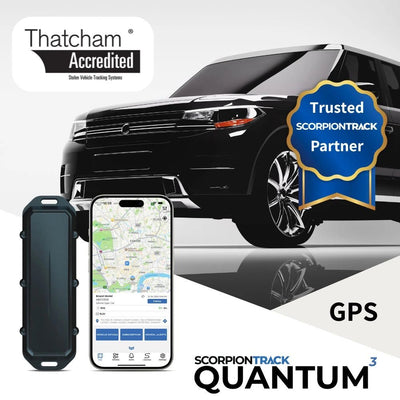
Key Takeaways The Key Difference Between GPS & RF Car Trackers
• GPS Trackers: Use satellites for real-time, global location tracking, accessible via a smartphone app from anywhere in the world.
• RF Trackers: Use Radio Frequency to transmit a signal over a shorter range, requiring a special receiver to find the vehicle locally.
• Primary Use: GPS is superior for live tracking and theft recovery over long distances, while RF is primarily used for finding a vehicle hidden nearby, such as in an underground car park.
• Technology: GPS is defeated by signal jammers or being hidden from satellites (e.g., in a metal container). RF can often penetrate these barriers but has a limited range.
• Best Solution: Many premium car trackers combine GPS, RF, and GSM technologies to provide a multi-layered defence against sophisticated theft methods.
The main difference between GPS and RF car trackers lies in the technology they use to locate your vehicle. GPS (Global Positioning System) trackers use satellites to provide a precise, real-time location that you can view on a map from anywhere in the world. In contrast, RF (Radio Frequency) trackers emit a signal that can be detected by a specialised handheld receiver over a shorter range. For comprehensive, global tracking and the highest level of security, GPS-based systems are the modern standard. To see the latest in tracking technology, you can explore a wide range of car trackers designed to protect your vehicle.

Understanding GPS Car Trackers
GPS technology has become a part of our daily lives, from navigating with our phones to tracking parcels. In the world of vehicle security, it provides a powerful and accessible way for owners to monitor their assets.
How GPS Tracking Works
A GPS tracker installed in your vehicle contains a receiver that communicates with a network of at least 24 satellites orbiting the Earth. By receiving signals from multiple satellites, the device can calculate its exact coordinates (latitude and longitude) with remarkable accuracy, often to within just a few metres.
This location data is then transmitted via a built-in GSM (Global System for Mobiles) module, using the same cellular networks as your mobile phone. The data is sent to a secure server, which you can then access through a smartphone app or web portal. This gives you the ability to see your car's live location, view past journeys, set up alerts for when it enters or leaves a specific area (geofencing), and monitor its speed and battery voltage.
The Advantages of GPS Trackers
• Global Coverage: As long as you have an internet connection, you can track your vehicle from anywhere in the world.
• Real-Time Data: You get live, up-to-the-minute location information.
• Rich Features: Most GPS car trackers come with apps that provide detailed journey history, speed reports, and security alerts.
• Police Support: In a theft scenario, live GPS data can be provided to the police, guiding them directly to the stolen vehicle for a faster recovery.
The Limitations of GPS
The biggest weakness of GPS is its reliance on satellite signals. Professional thieves are aware of this and may use GPS jammers illegal devices that block the tracker from receiving satellite signals. Furthermore, if a vehicle is hidden in a location where signals cannot penetrate, such as an underground car park or a lead-lined shipping container, the tracker will lose its connection and stop updating its location.
Understanding RF Car Trackers
Radio Frequency tracking is an older, yet still highly effective, technology that works differently from GPS. It doesn't rely on satellites and is instead based on a simple transmitter and receiver principle.
How RF Tracking Works
An RF tracker is a small, battery-powered beacon hidden within the vehicle. This beacon silently emits a unique radio frequency signal. It does not transmit constantly but can be activated remotely by a monitoring centre once a theft is reported.
To find the vehicle, a recovery agent or police officer uses a specialised handheld tracking unit. This unit is tuned to the specific frequency of the stolen car's beacon. As the agent gets closer to the vehicle, the signal on their receiver gets stronger, guiding them directly to its location. Think of it like a sophisticated game of "hot and cold."
The Advantages of RF Trackers
• Resistant to Jamming: RF signals are not affected by GPS jammers, which is a significant advantage against professional thieves.
• Penetrates Barriers: Radio waves can often pass through concrete, steel, and other materials that block GPS signals. This makes RF highly effective for finding cars hidden in underground garages or shipping containers.
• Hard to Detect: Because the beacon is often dormant until activated, it is very difficult for thieves to scan for and find.
The Limitations of RF
The primary drawback of RF technology is its limited range. The signal can typically only be picked up within a radius of a few miles. This means the recovery agent needs to be in the general vicinity of the vehicle to begin tracking it. It does not provide the global, instant visibility that GPS offers. You cannot simply open an app and see your car's location on a map.
Which is Better? The Power of a Combined Solution
Rather than viewing it as a competition, it is more accurate to see GPS and RF as complementary technologies. Each has strengths that cover the other's weaknesses. Recognising this, the most advanced car trackers on the market today incorporate multiple technologies into a single, robust system.
A premium, Thatcham-approved tracker will typically use:
- GPS for live, real-time tracking to give you and the police an immediate location.
- GSM to transmit that GPS data and other alerts to you and the monitoring centre.
- RF as a backup for when GPS fails, either due to jamming or the vehicle being hidden from satellite view.
This multi-layered approach provides the ultimate defence. If thieves jam the GPS signal, the monitoring centre can activate the RF beacon to continue the search. This ensures that even the most sophisticated criminals can be outsmarted. To find a system with the right level of protection for your vehicle, you can browse a complete collection of professional car trackers.
Conclusion: Choose a Multi-Layered Defence
While both GPS and RF trackers have their own merits, the best security solution for your vehicle is one that doesn't force you to choose between them. A system that combines the global reach of GPS with the signal-penetrating power of RF offers a nearly foolproof method for vehicle recovery. This ensures that whether your car is being driven down the motorway or hidden in a container, you have the technology needed to get it back.
Don't settle for a single point of failure. Invest in a comprehensive security system that covers all bases. To protect your vehicle against all modern theft techniques, explore our range of advanced car trackers today and secure your peace of mind.